Wednesday, 22 August 2012

Racks of Equipment

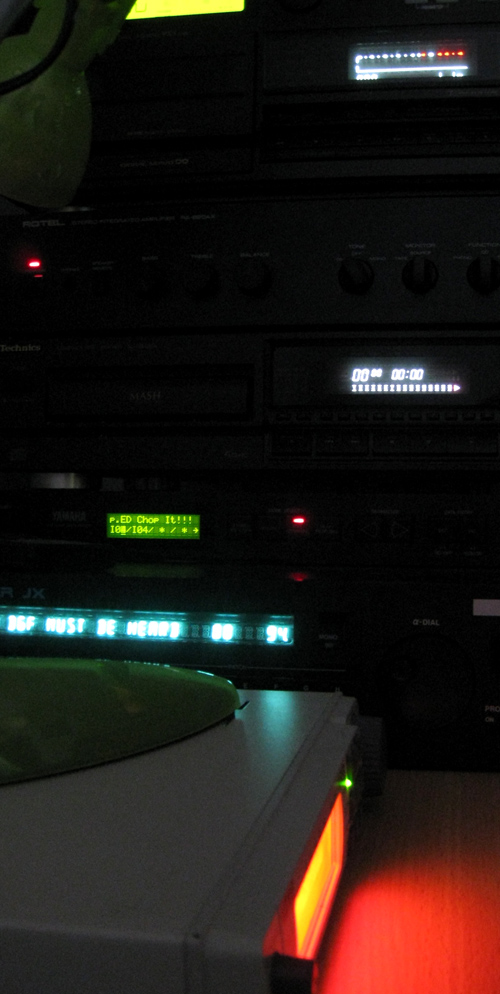
Rack of Equipment - Mammoth Studios
Like writing, composing music can often be a lonely affair, with countless hours, days and weeks spent alone in a room with just a PC and a rack of equipment for company.  At least musicians have that rack of equipment, with its mass of blinking lights and endless possibilities of sound generation.

Reports from the inner sanctum of Dayglo Fishermen indicate that, despite their enforced isolation from each other, the members of the band are experimenting and composing with remarkable clarity, imagination and cohesion, and making exceptionally good use of their racks of equipment.  Recently the keyboards and drums for tracks six, seven and eight of the new album have been completed at the band's London recording facility, Mammoth Studios.  Within the next month or two the guitars tracks for those three songs will be laid down, and then the delicate task of recording the vocal performances will be tackled.

As of this date two songs for the new album are completed, with only mixdown and some minor post-production work to be done.


Those few in a priveleged enough position to have listened to the songs are thrilled by what they have heard.  There has definitely been a buzz of excitement emanating from Dayglo Fishermen's production facilities over the last couple of months.  That, combined with the feel-good factor of the London Olympics, has created a positive summer vibe that has shimmered across the world with an almost intoxicating effect.


Sunday, 8 April 2012

Wave to the Aliens

By Peter Fothergill

Science fiction themes are not uncommon in Dayglo Fishermen songs.  Many songs contain subtle references - often the briefest of hints - to extra-terrestrial entities or events.  But there are several songs that are blatantly out of this world.  Here's a brief guide.

Strange Plaice - Album Cover
Dayglo Fishermen's ventures into science fiction began on the 'Strange Plaice' album.  The album opens with a section called 'Marsport'.  The  Story is that the Dayglo Fishermen band members are stuck on Mars after missing their shuttle flight back to Earth.  The next shuttle is not for another month, so the band decide to record a new album while they wait at the spaceport.  Fortunately their recording equipment and instruments are in their grav-car parked nearby.  They set it all up and the album kicks off.

The album closes with a piece named 'Departure'.  Having recorded the album, the band race to catch the next flight back to Earth.  They make it, with only 25 seconds of tape left.


Keep to the Path - Album Cover
The next significant track is on the 'Keep to the Path' album two years later.  It's a remix of 'Alien Wave', know as the Bass Hound Mix (there were in total three versions of 'Alien Wave' featured on five albums.  This was the only version to feature the science fiction lyrics).

The song is about a group of extra-terrestrial visitors who teleport down to Earth to explore.  They are particularly sensitive to rhythmic bass sounds and hear what they believe to be an animal.  While investigating the sound they stumble upon a cave hosting a rave.  Hypnotised by the pounding music they misbehave badly.  They leave, realising that there is definitely no disgrace in feeling the bass.


Animate - Album Cover
The 'Animate' album features one of the strangest science fiction songs in Dayglo Fishermen's back catalogue.  Named 'Flaxen', the song is full of metaphors which is likely to be confusing for the uninitiated.  It's about an alien race, known as the Phantoms, who are rendering every sentient being they encounter insane, and then destroying their home star systems.  They go unchallenged for millennia until they approach the planet of the Flaxen.  Lead by the entity known as the Mystic Mite, the Flaxen, unaffected by the mind-warping abilities of the Phantoms, use their transcendental powers to form a super-dense gravity field that consumes the Phantoms.  It is likely to take several close examinations of the song to fully appreciate its lyrics.


'Space Dog' was the band's first album to be recorded after they relocated to South East England and recruited Ginny as a vocalist.  It contains two science fiction tracks, a real treat for fans of the genre.

Space Dog - Album Cover
The title track, 'Space Dog', is about a wild alien creature that bears some resemblance to a dog.  She's obsessed with speed and is regarded with a great deal of awe by the residents of all the planets she passes.  During a particularly reckless journey through the Orion Nebula her excessive speed causes a rift in reality that sends her out of control, causing her to crash land on Earth in North East England.  The impact, during a particularly harsh winter, causes her considerable injury, but she manages to make her way across the frigid landscape to a warm and friendly town where she can recover.  She is soon able to leave Earth and continue her quest, whatever that may be.

The second song is named 'Cool'.  The song takes us on a personal journey.  It's about a woman whose mundane life is interrupted when she sees what she believes to be numerous non-terrestrial vehicles emerging from a mysterious glow in the sky.  The experience changes her outlook on life, and enables her to generate a great deal of personal wealth - essential for her to help the occupants of the vehicles, known as 'Guardians'.  Their purpose on Earth is to rise up and eliminate the fear and dread that exists in the world.  One day the woman returns home to find that it contains a golden dome, which is where, annoyingly, the song ends.  We are left wondering what the dome signifies, and whether the Guardians are benevolent or malevolent.  Listening to the song, especially after a reasonable amount of wine, can be a thought-provoking experience.


Dayglo Fishermen's next album, named 'Painting Aliens', is widely considered to be the band's classic pop album.  But it also contains two of the band's finest science fiction tracks.

Painting Aliens - Album Cover
The title track, 'Painting Aliens', is an upbeat song about a young girl who watches the sky every night, looking for something - anything.  One night she sees a bright blue and red saucer heading straight for her.  And then it vanishes.  Standing beside her is an alien.  He claims to be a friend from a far off star who had learned her language from books.  And he wants to use her phone.  She soon finds herself strapped into the saucer and taken high above the atmosphere. She's offered strange food, which she sensibly declines.  She looks back at the lights of Earth in a daze and wonders just how amazed people down there would be if they knew where she was.

The second science fiction track on the album, named 'Something's Watching', is a far more sinister song which plays on our fear of darkness, and the paranoia it can cause. The song is about someone who senses a presence in the darkness, something evil.  She's desperate for help, but her pleas are ignored and she's left alone.  She begins to believe she's going crazy, but then she's impregnated with something.  It grows inside her and causes her to experience new visions and hear the sounds of an animal - a hound.  The animal could well be the same animal mentioned in the Bass Hound Mix of 'Alien Wave'.  Chilling stuff.

Comet Nerdlinger - Album Cover
The 'Comet Nerdlinger' album, despite it's name, contains only one science fiction track.  The song 'Nerdlinger One' is about a black comet, designated Nerdlinger One, which is drifting closer and closer to the inner Solar System.  As usual, when it gets close enough to the sun, it develops a bright tail.  But this is no ordinary comet.  As the people of Earth marvel at the comet's beauty when its tail sweeps across the Earth the microscopic lifeforms within it descend and infect everyone on the planet.  Humanity is dissolved and rises up and out of the atmosphere to merge with the comet, and to become part of the infection that will one day dissolve the beings of another world.


I Can See a Boat ... It No Longer Floats
Album Cover
Finally, the album 'I Can See a Boat ... It No Longer Floats' features quite an extreme science fiction track named 'Screams Inside My Head'.

A woman thinks she's going mad and longs for the bizarre thoughts in her head, especially those of a giant sphere, to fall silent.  But she soon finds out she's not the only one with such thoughts.  With a friend, who's also experiencing the same mental phenomena, she sets out to find the giant sphere, which she believes contains those responsible for her strange thoughts.  They find the sphere and enter it only to be overwhelmed by its contents.  The only way they can cope with life after such an experience is to be totally alone.

This song, depending on how it's interpreted, could be linked to 'Cool' or 'Something's Watching'. 

As with all Dayglo Fishermen's songs, especially the more fantastic ones, the true meaning of the lyrics is wide open to debate.  I'll let you all ponder such things without any more from me...

Saturday, 24 March 2012

Piano

Every album needs a slow and melancholic song inspired by cold, wet weather.  And the fifth song to enter production for Dayglo Fishermen's new album appears to be that song.

In possession of a chord sequence written by Sean on a suitably dark and grey January day, Peter set work in Mammoth Studios.  Sean had recommended a tempo of 90 beats-per-minute but Peter was in a risk-taking mood, so he knocked it down to 80.  While not as lethargic as the legendary song, Opium (which Peter worked on with Richard for the 'L'Amour De La Vie' album in the late 1980s), it was still slow enough to dampen the mood of even the most optimistic of creatures.

Selecting a mellow octave-arpeggiated pad sound as the song's backbone, Peter quickly pieced together the song, adding Korg sampled textures to gently build some more density into the latter parts of the track.  A simplified drum sequence was then added to prevent the mood slipping too far.

The digital piano at Mammoth Studios
But something was still missing.  It was something 'real' -  something acoustic sounding to cut through the layers of synthetic sound and add an organic dimension to the music.  That 'something' was Mammoth Studios' new digital piano.  The latest song was the ideal one to feature the new instrument's incredibly realistic sound.

Using the piano sparingly, Peter added some gentle chords and melodies to the instrumental sections of the song, and then some sparse and deep notes to the other sections.

With the song's backing music complete it now awaits its vocals.

Tuesday, 7 February 2012

The Origin of 'Fish'

By Peter Fothergill

Curiosity was ultimately the reason Dayglo Fishermen came into being.  Curiosity about a small recording studio in Hexham, Northumberland, to be exact.  Artilite Studios was well-known in the town's young musical community, due mainly to the fact that from the time I set up the facility in 1987 my brother, David, would often mention it to his friends at high school.  After that members of school bands would quite regularly turn up on my doorstep wanting to record a song, or even wanting me to join their band as they'd heard I had a keyboard (I did end up joining two bands for a short time, but that's another story!).

It was in March 1990 that two of David's friends, Eamonn Maddick and Peter Carmichael, requested a tour of the studio during a break from university.  I agreed, and suggested that the best way for them to get to know the studio was for us all to write and record a song.  During the Easter holidays that year the four of us did just that.

Artlite Studios - Early 1990s
At the time the studio was based around an Atari ST running the Iconix sequencer, the legendary Korg M1 Synthesiser, and a Yamaha MT1X multi-track recorder.  Other sound modules included the Yamaha TX81Z, Roland MKS-70, and the Casio RZ-1 drum machine and sampler.  All of that equipment was utilised to varying degrees as we slowly, and without any planning at all, pieced together the unusual and now classic Dayglo Fishermen track, 'Fish'.

I started with a demonstration of a simple drum pattern, using the M1's drum sounds rather than the RZ-1's.  It was an on-the-beat bass drum with a ticking hi-hat on each sixteenth note.  It was logical to do a bass line next, so I chose a squidgy analogue sound on the MKS-70 and asked for someone to have a go at playing something.  After quantisation and the correction of a few notes a rather interesting riff emerged.  Over the next couple of hours we added a few more sections and some breaks and drum fills.

The Original Dayglo Fishermen Members: Eamonn Maddick,
Peter Carmichael, Peter Fothergill and David Fothergill
Summer 1990
The drums and bass seemed too intense for vocals, so to demonstrate how to record voices I created a couple of quiet sections of music using an edited version of the M1's famous 'Universe' sound. Rather than write lyrics a poem called 'The Catch', by Charles Bokowski, was chosen.  Peter Carmichael volunteered to read it. The poem and Peter's smooth delivery of it fitted very well with the music.  We had to miss out the last few lines of the poem, but we finished on the poem's most dramatic line, 'And then it was dead', which worked very well.  In the final mix I added some delay to the delivery of that line which emphasised the drama perfectly.

The only sampling capability I had at the time was in the RZ-1.  The drum machine could sample four 0.2 second samples to create new pecussion sounds.  My guests were very interested in this feature so we used it to sample the words 'fish' and 'arp' which were then spread liberally throughout the song.

Guitars were next.  There was often a guitar lying around the studio, courtesy of Richard Burton who I recorded with regularly on solo projects (Richard would join Dayglo Fishermen several months later in December 1990).  David said he would like to play the guitar part.  Despite his complete lack of experience the deep and mournful guitar track he came up with was an astonishingly perfect fit for the song.  After that we added a sample of a cheering concert audience to the intro.  It created a rousing start to the song and finished things off nicely.

The Album Cover for 'Drenched'
Design and Artwork by
David Fothergill
We were all so pleased with the song that a few months later, after everyone had returned from university for the summer break, we set about recording more songs under the name 'Dayglo Fishermen'.  By August we had completed ten songs which we released as an album named 'Drenched'.

To hear 'Fish' and the other tracks on the band's first album, 'Drenched', visit www.dayglofishermen.com.

Thursday, 2 February 2012

Spontaneity

The exact moment that work starts on a new album is often planned well in advance.  That is true for many bands, but for Dayglo Fishermen the decision to start recording a new album is always spontaneous, and triggered by something special.

During September 2011, 17 Months after the release of Dayglo Fishermen’s last studio album, ‘Moons That Cast Their Light’, the band suddenly started production of their new album.  The trigger that set things in motion was the opening of the band's new London production facility, Mammoth Studios.  Over the last five months the drum, bass and keyboard sequences for four tracks have been completed, with a fifth track well into production.

Mammoth Studios
Mammoth Studios is dedicated to the recording of Dayglo Fishermen’s electronic sections of music, which means that the guitar and vocals are still recorded at the band’s primary facility, Cozmic Studios, in Buckinghamshire.  Despite this new separation of tasks there is no sense of isolation.  Early mixes of the tracks are digitally delivered to other band members allowing guitar and vocal parts to be composed and rehearsed at leisure.  The new distributed work pattern appears to be working well, with completed guitar tracks on the first two songs sounding nothing short of phenomenal.

More guitar sections will be recorded during the next session at Cozmic Studios, scheduled for later this month.

Monday, 30 January 2012

Welcome

Welcome to the Dayglo Fishermen Production Log.  This site will feature articles about the behind-the-scenes activities of the band, covering topics including the composition and recording of new songs, video production, rehearsals for live performances, and indeed anything else that is of interest to the outside world.

We hope that you enjoy delving into the once secret inner sanctums of Dayglo Fishermen.